Peer Review Process
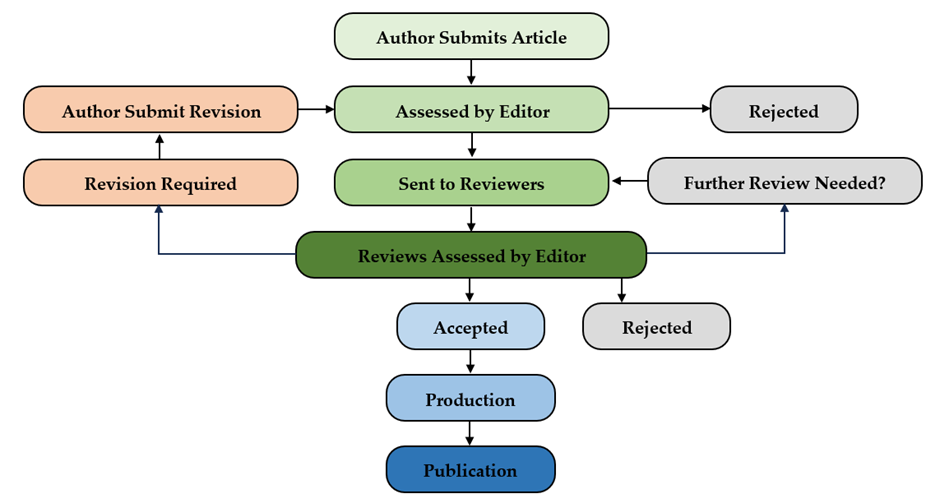
Manuscripts submitted to the journal undergo an initial screening by the Editorial Board. Those deemed suitable are then forwarded to peer reviewers for evaluation through a double-blind review process. Each manuscript is assessed by at least two independent reviewers in terms of both substantive content and technical quality. Based on the reviewers’ feedback, the manuscripts are returned to the authors for revision. The review process takes about 4 months (16 weeks), according to the journal workload. The authors can track their manuscripts through this system.
Initial screening
All submissions are initially evaluated by the Editor-in-Chief to assess their relevance to the journal’s scope and discipline, compliance with submission guidelines, and adherence to ethical standards, including originality and freedom from plagiarism. Manuscripts that fall outside the journal’s scope or fail to meet ethical or technical requirements are rejected at this stage.
Reviewer assignment
Manuscripts that pass the initial screening are assigned to the editor, who selects two independent reviewers with relevant expertise.
Peer review
The selected reviewers conduct a thorough evaluation of the manuscript and submit their assessments and recommendations to the Editor-in-Chief.
First decision
Based on the reviewers’ recommendations, the manuscript may be rejected, accepted without revision, or returned to the authors for minor or major revision. Manuscripts accepted without revision are returned to the corresponding author for final proofreading. The final acceptance decision is made by the Editor-in-Chief upon recommendation from the Editor and with approval from the Editorial Board.
Revision
Manuscripts requiring revision are returned to the authors for modification. Revised submissions are re-evaluated by the editor to determine whether the authors have adequately addressed the reviewers’ comments and whether the revisions meet the journal’s standards. If the revisions are deemed insufficient, additional rounds of revision may be requested.
Final decision
A final decision is made to accept or reject the manuscript. Rejection at this stage indicates that the required revisions were not satisfactorily completed or did not meet the journal’s quality standards. Accepted manuscripts proceed to language editing and typesetting prior to publication.
Publication
Accepted articles are published in the journal. The sequence of articles within an issue is determined by the Editorial Team. Depending on thematic relevance and editorial considerations, some accepted articles may be scheduled for publication in a subsequent issue.
REVIEW GUIDELINES
When reviewing the article, please consider the following aspects to help guide your review report for research articles:
-
Is the manuscript clear, relevant to the field, and presented in a well-structured manner?
-
Is there an aim, research question, or reason for doing the research, and has this research been put in the context of previous work? Is a gap in knowledge identified?
-
Are the cited references mostly recent publications (within the last 5 years) and relevant? Does it include an excessive number of self-citations?
-
Is the manuscript scientifically sound, and is the experimental design appropriate to test the hypothesis?
-
Are the manuscript’s results reproducible based on the details given in the methods section?
-
Are the figures/tables/images/schemes appropriate? Do they properly show the data? Are they easy to interpret and understand? Is the data interpreted appropriately and consistently throughout the manuscript? Please include details regarding the statistical analysis or data acquired from specific databases.
-
Have the results been presented and discussed clearly and completely?
-
Are the conclusions consistent with the evidence and arguments presented?
-
Do you have any other suggestions that might help the author(s) strengthen their paper to make it more applicable to the community?